
Search ‘job management software Australia’ and you will find a long list of platforms all claiming to solve the same problems. Scheduling, invoicing, job tracking, mobile access — every vendor promises it all. The reality is that most of these tools were not built for the specific operational requirements of Australian HVAC, refrigeration, and electrical businesses. This guide cuts through the noise.
Choosing the wrong platform is not just an inconvenience. It means a disrupted workflow during implementation, a team that resists adoption, and often a second migration eighteen months later when the gaps become undeniable. Getting this decision right the first time matters — and that starts with knowing exactly what to look for.
Why Generic Job Management Tools Fall Short
Many of the most heavily marketed job management platforms in Australia were originally built for IT service operations, small residential trade teams, or international enterprise markets. They have been adapted for the Australian trades market — but adaptation is not the same as purpose-built design.
The differences show up in the details. Asset management systems that cannot handle multi-site equipment registers. Scheduling tools that work for a five-person team but break down at twenty. Compliance features that were added as afterthoughts rather than embedded in the workflow. Mobile apps that require constant connectivity in environments where signal is inconsistent.
For a growing Australian HVAC or electrical business, these gaps are not minor annoyances. They directly impact your ability to win maintenance contracts, pass compliance audits, and scale your team without proportionally scaling your admin overhead.
The 7 Features That Actually Matter
When evaluating job management software for a mid-market Australian trade business, these are the capabilities that genuinely move the needle:
Real-time scheduling and dispatch. Not a static calendar that gets updated at the start of each day — a live board that reflects technician locations, availability, and job status as they change throughout the day. When a job runs long or a client cancels, you need to redeploy instantly.
Asset tracking and service history. Every piece of equipment your business maintains should have a digital record showing its full lifecycle — installation, service visits, test results, parts replaced, and compliance documentation. Technicians should be able to access this from their mobile before they arrive on site.
Compliance documentation embedded in job workflows. SWMS, safety checklists, test records, and certifications should be captured as a natural part of completing a job — not as a separate administrative task that happens later, if at all.
Mobile access that works offline. Trade businesses work in basements, plant rooms, remote sites, and industrial facilities where connectivity is unreliable. Your mobile app needs to function fully without a live internet connection and sync when connectivity is restored.
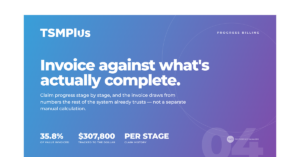
On-site quoting and invoicing. The faster you can quote and invoice, the faster you get paid. Job management software that enables technicians to generate quotes and invoices on site — integrated directly with your accounting platform — eliminates the 7–10 day billing delay that drains working capital from most manual trade businesses.
Business reporting and job costing. You should be able to see, at any moment, which job types are most profitable, which technicians are most efficient, and where your margins are being eroded. Waiting until month-end for this information means making decisions too late.
Australian data hosting. For businesses managing client compliance data, equipment histories, and financial records, where your data is stored matters for both regulatory compliance and practical data sovereignty. A platform hosted on Australian soil is a non-negotiable for many commercial clients.
What Enterprise-Level Capability Actually Looks Like
There is a common misconception that enterprise-grade field service software is only relevant for large corporations. In practice, the operational needs of a well-run fifteen-technician HVAC business are more complex than many enterprise IT service desks. You are managing mobile workers across multiple sites, tracking physical assets, ensuring regulatory compliance, and running a cash-intensive service operation — simultaneously.
Enterprise-level capability for a business at this scale means having the depth to handle complexity without requiring complexity to operate. Powerful scheduling that a dispatcher can learn in a day. Asset management that a technician can navigate on a phone in a plant room. Reporting that gives the owner visibility without requiring them to build custom spreadsheet models.
How TSMPlus Delivers All 7 Without the Complexity
TSMPlus was developed over more than 30 years of working directly with Australian HVAC, refrigeration, and electrical businesses. It is not a global platform adapted for the Australian market — it was built here, for this market, based on direct experience with the operational realities that these businesses face.
The platform is hosted entirely within Microsoft Azure’s Australian data centres. Every feature — scheduling, asset management, compliance documentation, mobile access, quoting, invoicing, and reporting — is built into a single integrated platform. There is no need to stitch together four different tools and manage the gaps between them.
TSMPlus is also designed to scale. The same platform that works for a five-technician team also handles the operational complexity of a fifty-technician enterprise. You do not outgrow it at the point where growth matters most.
Before you make your next software decision, it is worth seeing how a platform purpose-built for your industry actually operates in practice. The difference between a generic tool and a fit-for-purpose platform becomes obvious very quickly.
See TSMPlus in action. Start your free trial or book a live demo at theservicemanager.com — and see for yourself why Australian HVAC and electrical businesses are choosing the platform built for them.